
The 2023 forest fire season in Greece was one of the country’s most devastating, exposing significant weaknesses in its fire management system. Over 1400 km2 burned nationwide, destroying hundreds of structures, and claiming over 20 lives.
The season was defined by a massive fire in the Evros prefecture near the border with Turkey. Beginning on August 18. The fires in the Alexandroupoli and Dadia Forest Park areas burned over 935 km2, an area nearly three times the country’s annual average burnt area between 2008 and 2020. The blaze of the wildfire is considered the largest ever recorded in the EU since the European Forest Fire Information Service (EFFIS) began data collection in 2000 (Dosiou et al., 2024). The extended fire inflicted widespread damage, affecting 58% of the Dadia National Forest Park’s total area. The fire’s intensity was exacerbated by prevailing weather conditions, including a lack of significant rainfall and temperatures exceeding 40°C, which were above the climatological average. These conditions created a favorable environment for the fire’s rapid spread (Michailidis et al., 2024).
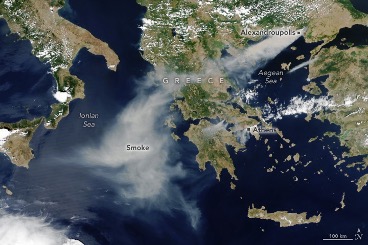
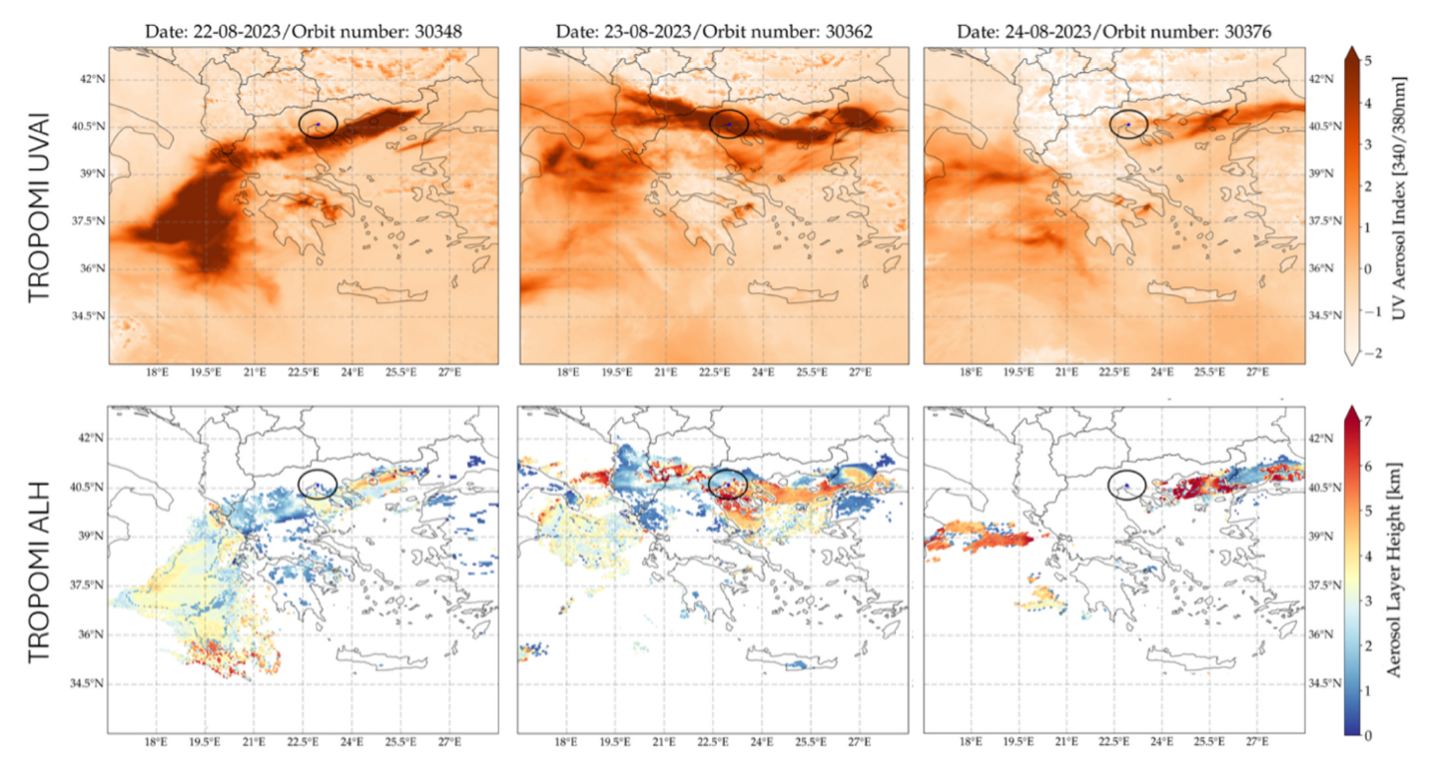
The fire’s intense activity also generated pyrocumulonimbus (pyroCb) clouds over the burned areas, which are visible in satellite imagery of the affected region between August 20 and 26, 2023 (Michailidis et al., 2024). The smoke plumes from the fires were vast, carried by winds across the northern Aegean Sea and Greek mainland, reaching as far as the coasts of northern Africa and southern Italy.
On August 22, while the Evros fire was still burning, a new fire ignited in multiple spots on the outskirts of Athens. As the fire moved slowly up the slopes of Mount Parnitha, it was burning for for four days. This blaze consumed 60.57 km2 and dealt a final blow to the Parnitha National Park, burning what was spared from devastating fires in 2007 and 2021.
Sources for the text: www.iawfonline.org/article/overview-2023-greece/ and Michailidis et al., 2024.
Data source: Michailidis et al., 2024 (https://www.sciencedirect.com/science/article/abs/pii/S0169809524004824), no relative publication for Athens data.
For this event, lidar data from the ACTRIS-EARLINET database were used for the stations of Thessaloniki (Aristotle University of Thessaloniki, Thessaloniki; THE) and Athens (National Technical University of Athens, Physics Department; ATZ).